


BATs is a blockchain investigation platform used by law enforcement and the IRS to trace complex crypto transactions. It aggregates data from wallets, exchanges, and subpoenas, helping investigators detect fraud, follow financial flows, and build stronger cases.
My Contribution
As the sole Product Designer on BATs, I was responsible for reshaping the experience. Over five years, my work spanned redesigning the information architecture, creating investigative workflows, and building a scalable design system. I delivered more than 70 redesigned screens, from dashboards and transaction flows to detailed graphs, admin tools, and reporting interfaces.
Client
BATs - Blockchain Investigations SaaS Platform
Category
Fintech, Blockchain/Crypto Web3, Security
Team
2 Developers, 1 Product Owner
Timeline
1 Months
Problem
When I joined BATs, the platform already contained a lot of data: dashboards, transaction details, addresses, users, and case files. But what it didn’t have was structure. Investigators from agencies like the IRS told us they struggled to follow even simple workflows.
The existing designs were outdated and fragmented. There was no real flow tailored to the main user type, investigators. This made tracing complex blockchain transactions slow, confusing, and inefficient.
Solution
The focus was on introducing clear, investigator-centred flows. My goal was to reduce cognitive load, increase efficiency, and make complex investigations more intuitive.
RESEARCH
Key Findings
Understanding the pain points
I started by mapping out investigator journeys based on feedback gathered from the customer service team and key IRS stakeholders. These insights highlighted pain points such as:
- “I don’t know where to begin when opening a case.”
- “The steps to connect transactions feel scattered.”
- “I lose track of progress when switching between dashboards.”
Translating into flows
Using this input, I created user flows that defined clear entry points, logical steps, and outcomes. These flows then informed the redesign of key screens, simplifying layouts and surfacing the most relevant data at each stage.
Collaboration & Constraints
Dev collaboration
Working with developers was primarily async due to distributed teams. I collaborated closely through shared tools, annotated designs, and clear documentation to ensure smooth handoff.
Key constraints
- No direct access to end users → I relied on feedback passed through customer service and stakeholder proxies.
- Legacy codebase → Certain UI patterns had to be reworked to fit technical realities.
- Limited dev bandwidth → I prioritised changes that gave maximum user impact with minimal development lift.
DESIGN
Redesigning Key Screens
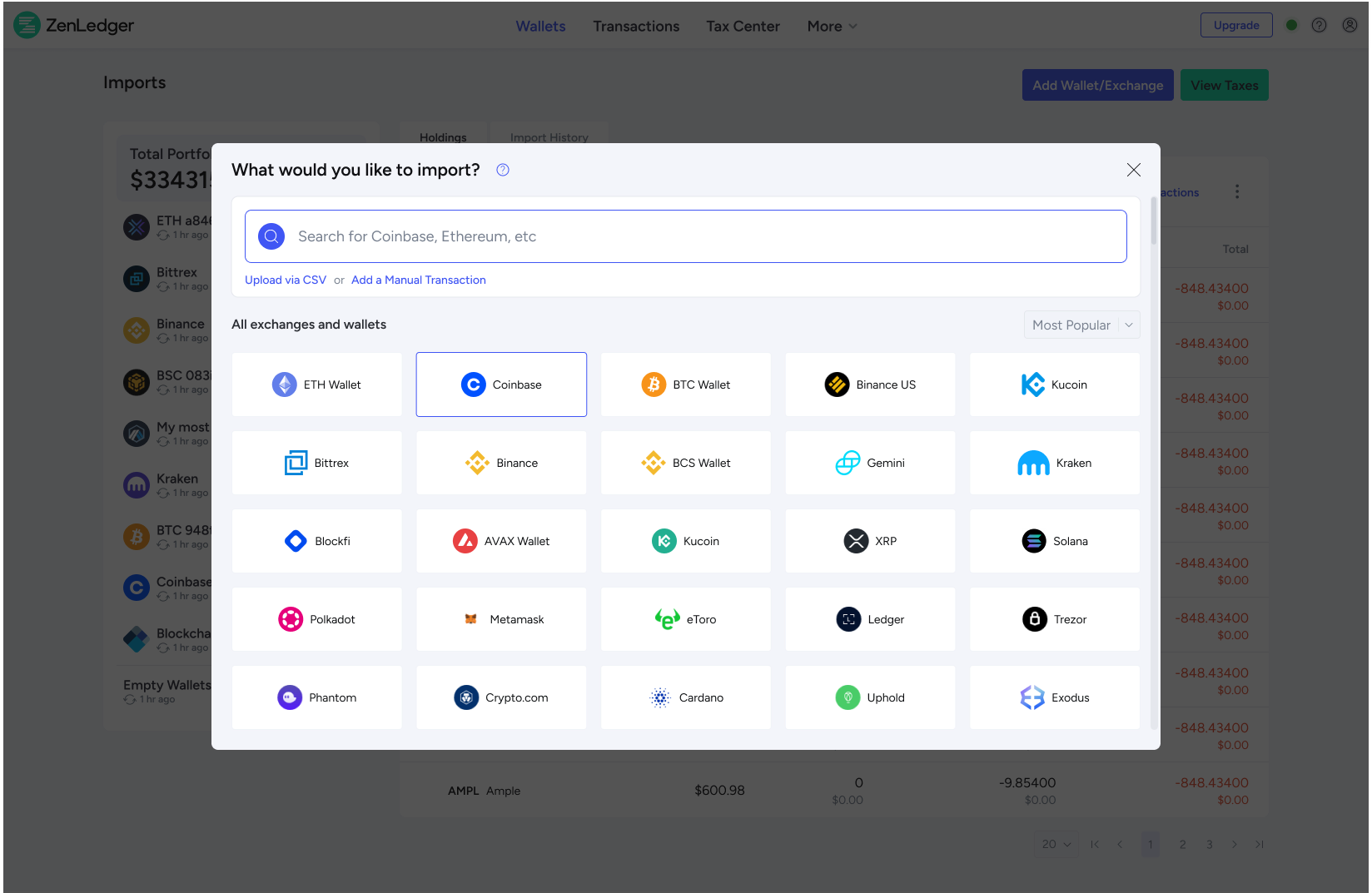
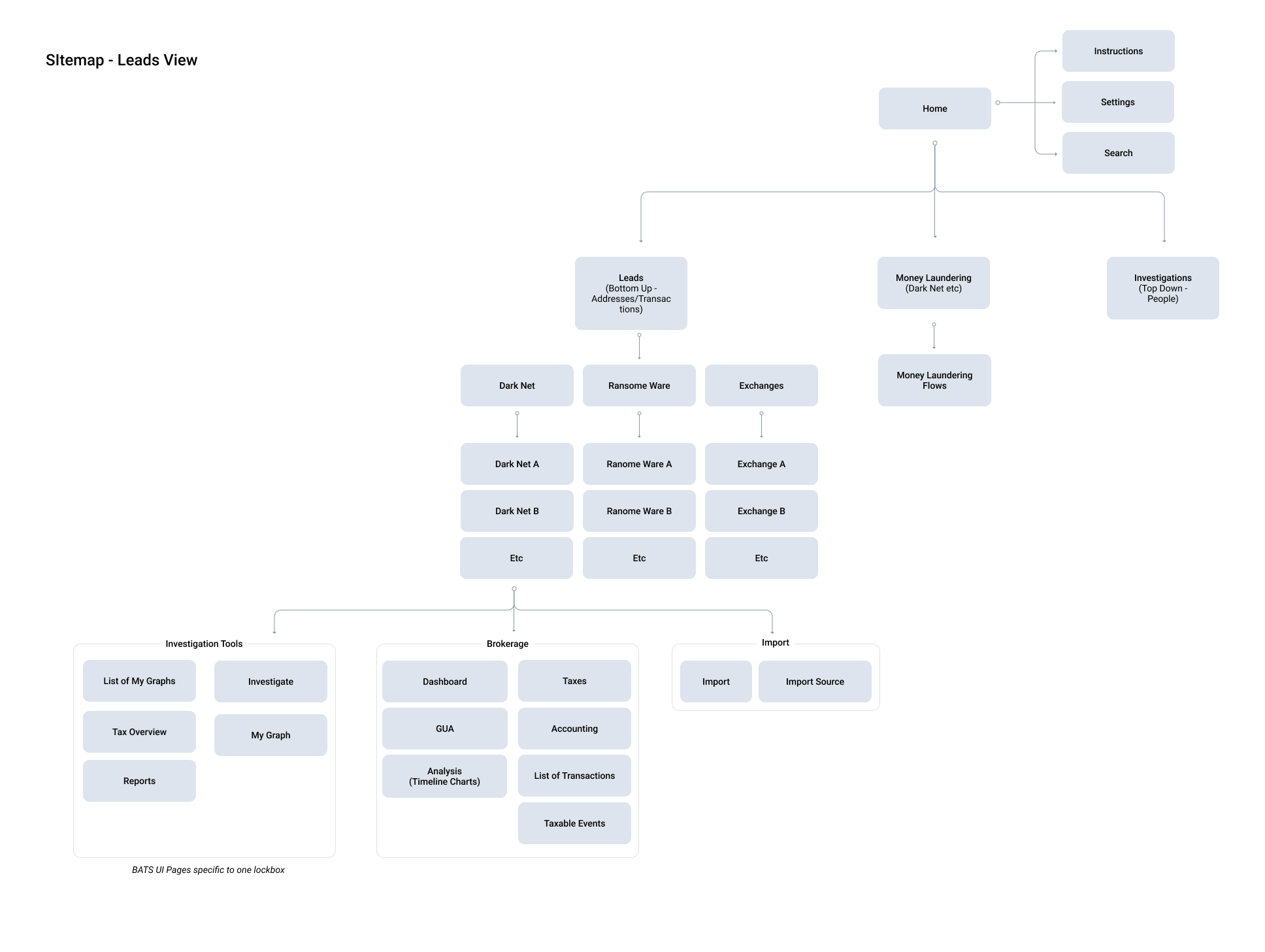
Sitemap - Leads
Sitemap showing the bottom up flows, where an investigation starts with an address or transactions.
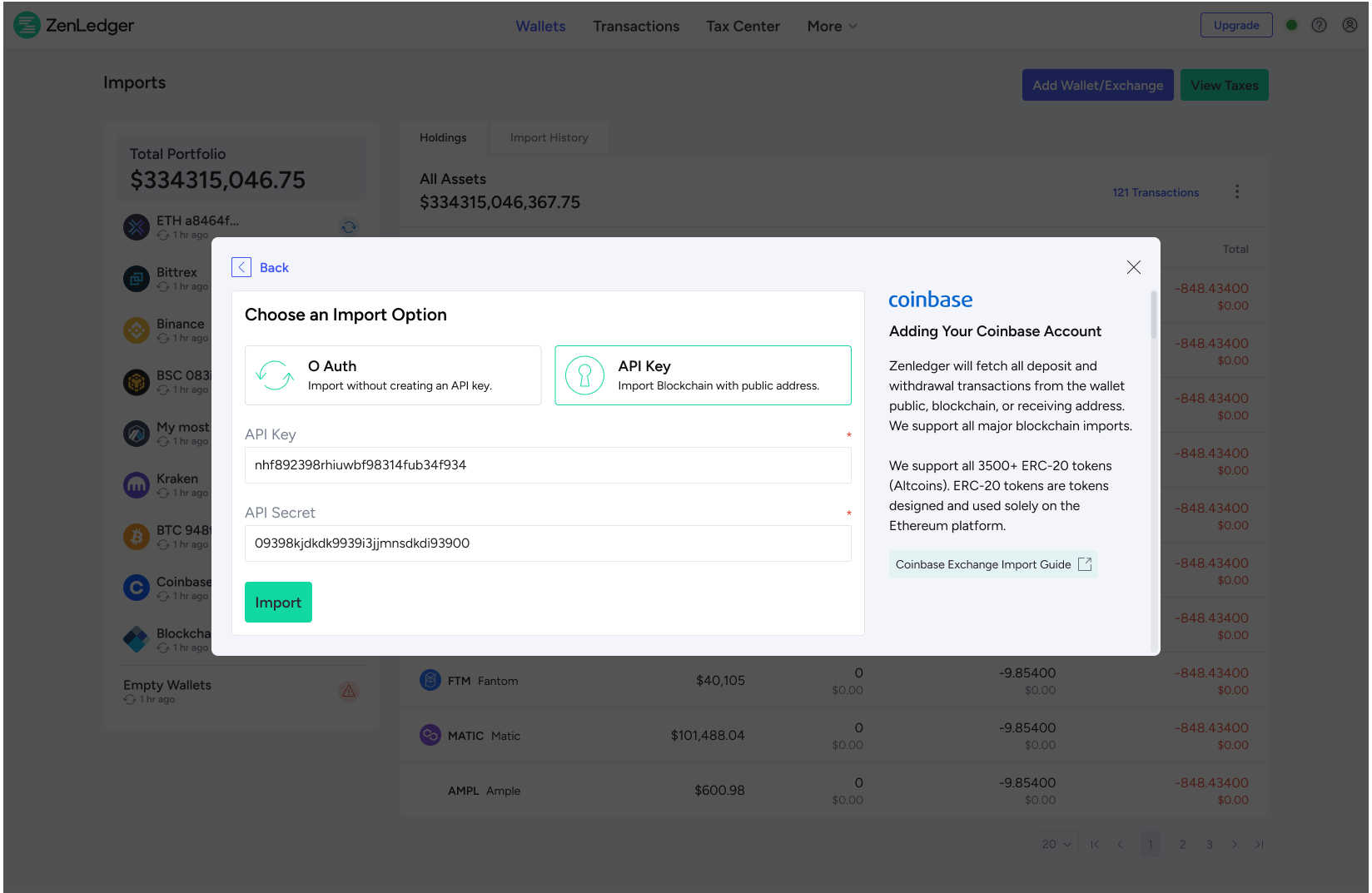
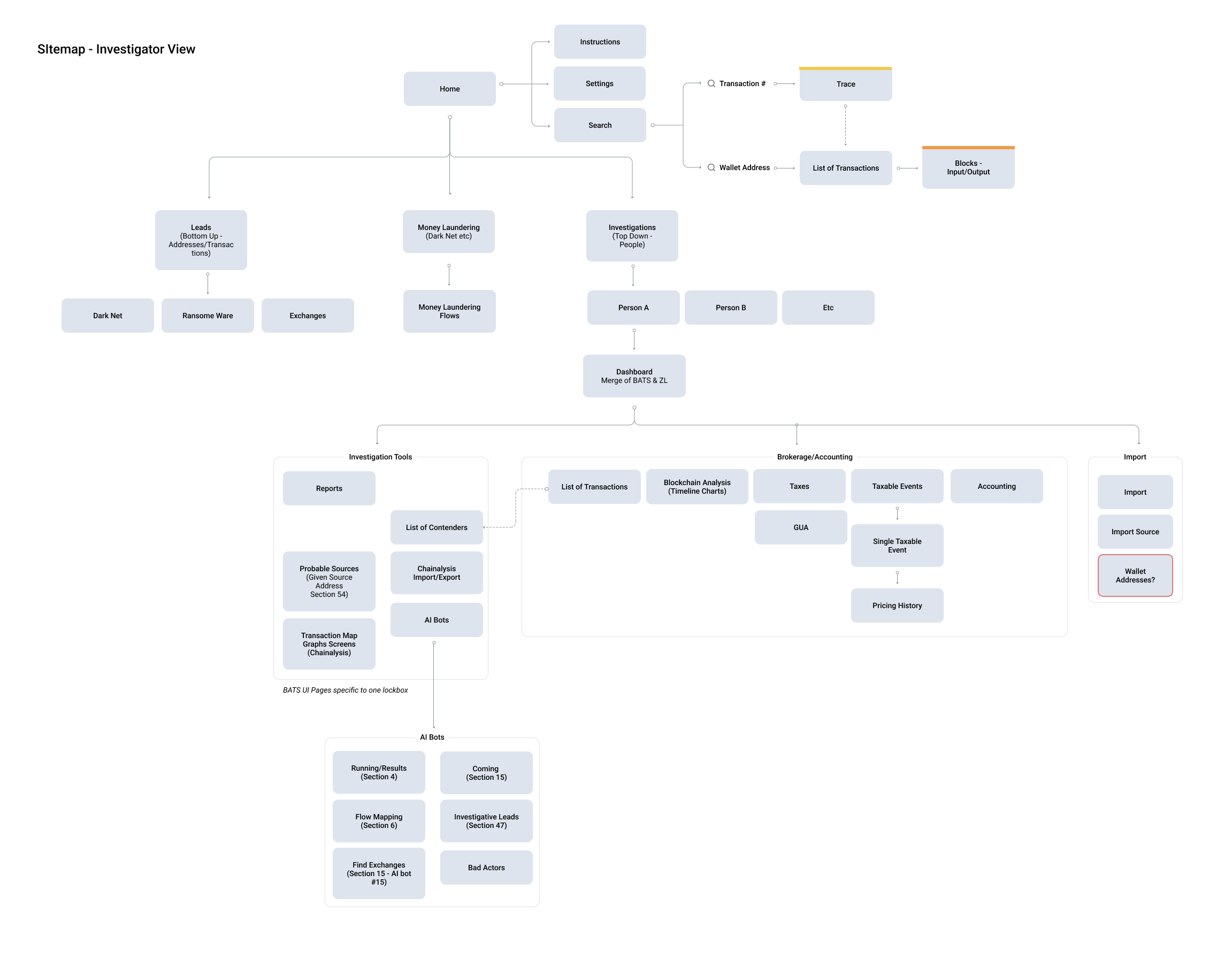
Sitemap - Investigators
Sitemap showing the top down flows, where an investigation starts with a person.
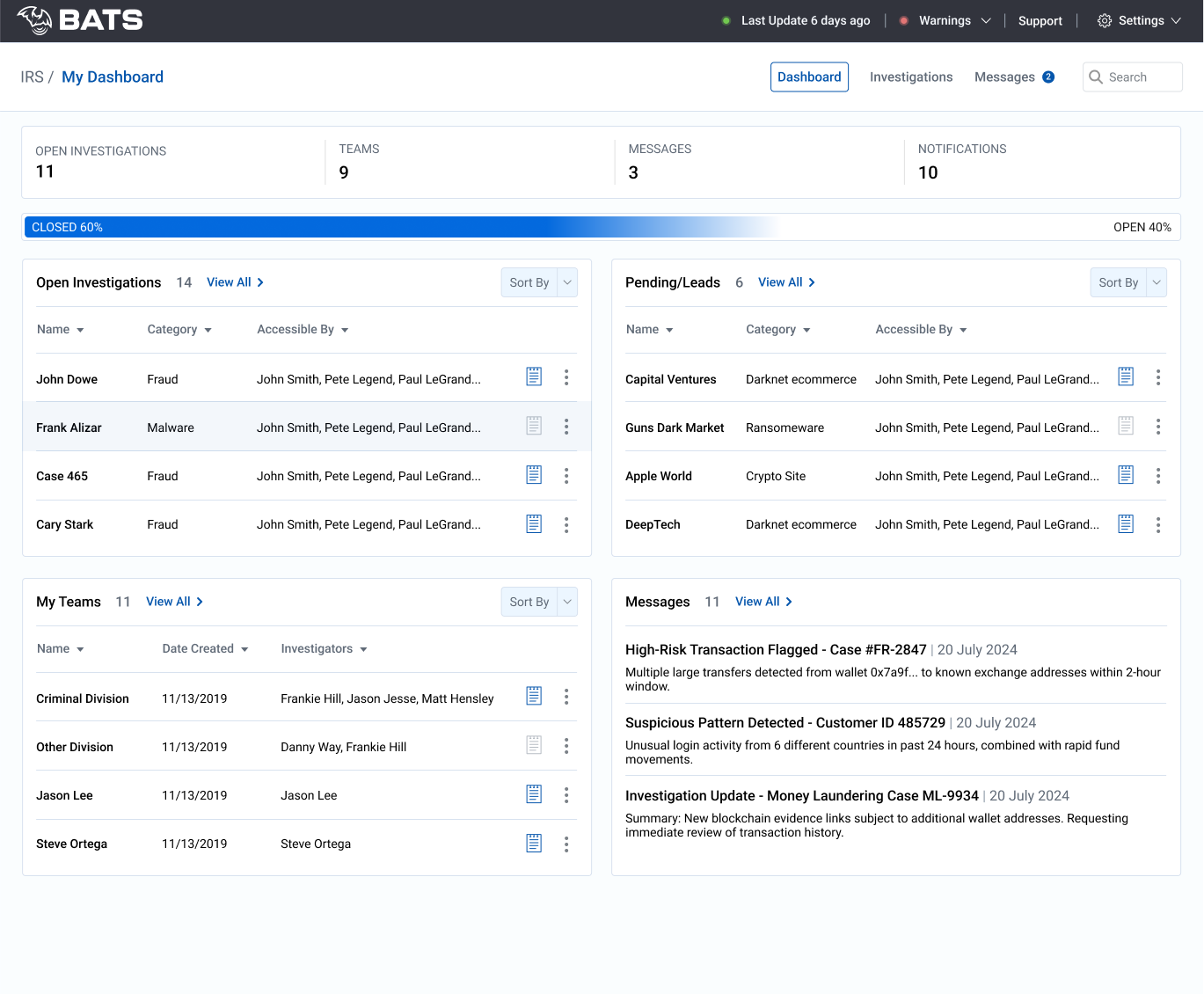
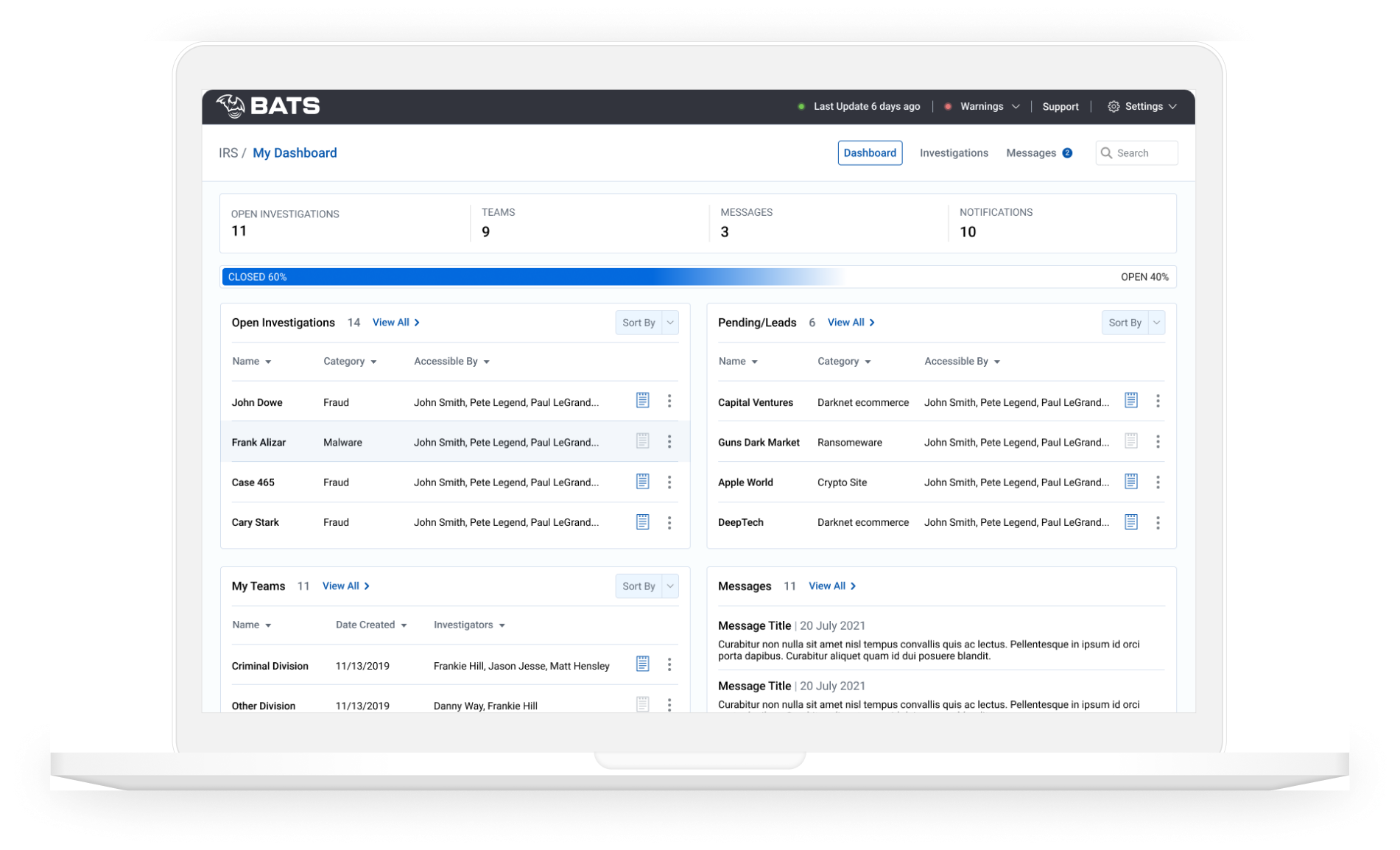
Dashboard
Reorganised to highlight priority cases and active investigations.
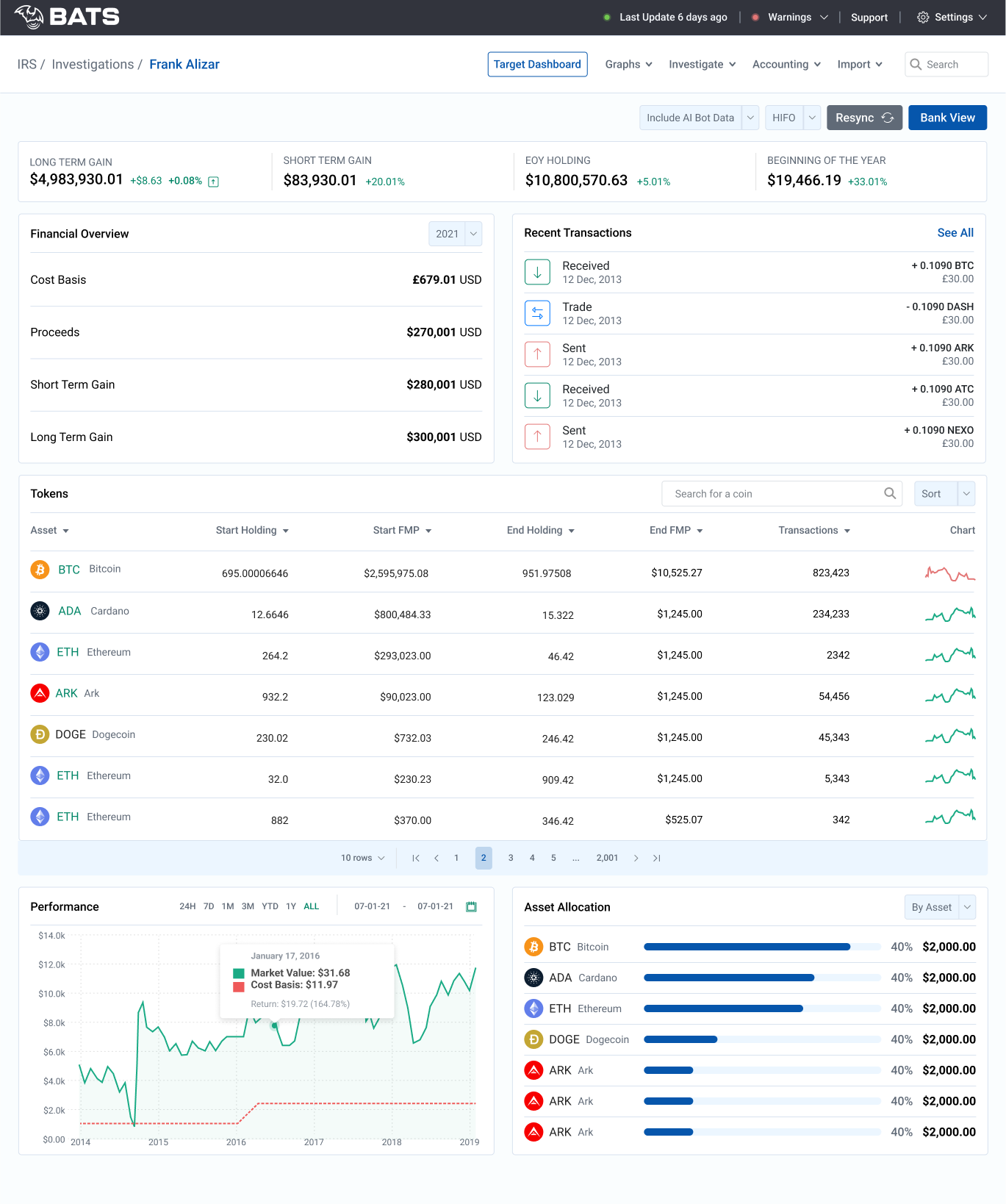
Target Dashboard
Redesigned for a clear view of most pertinent information for targets.
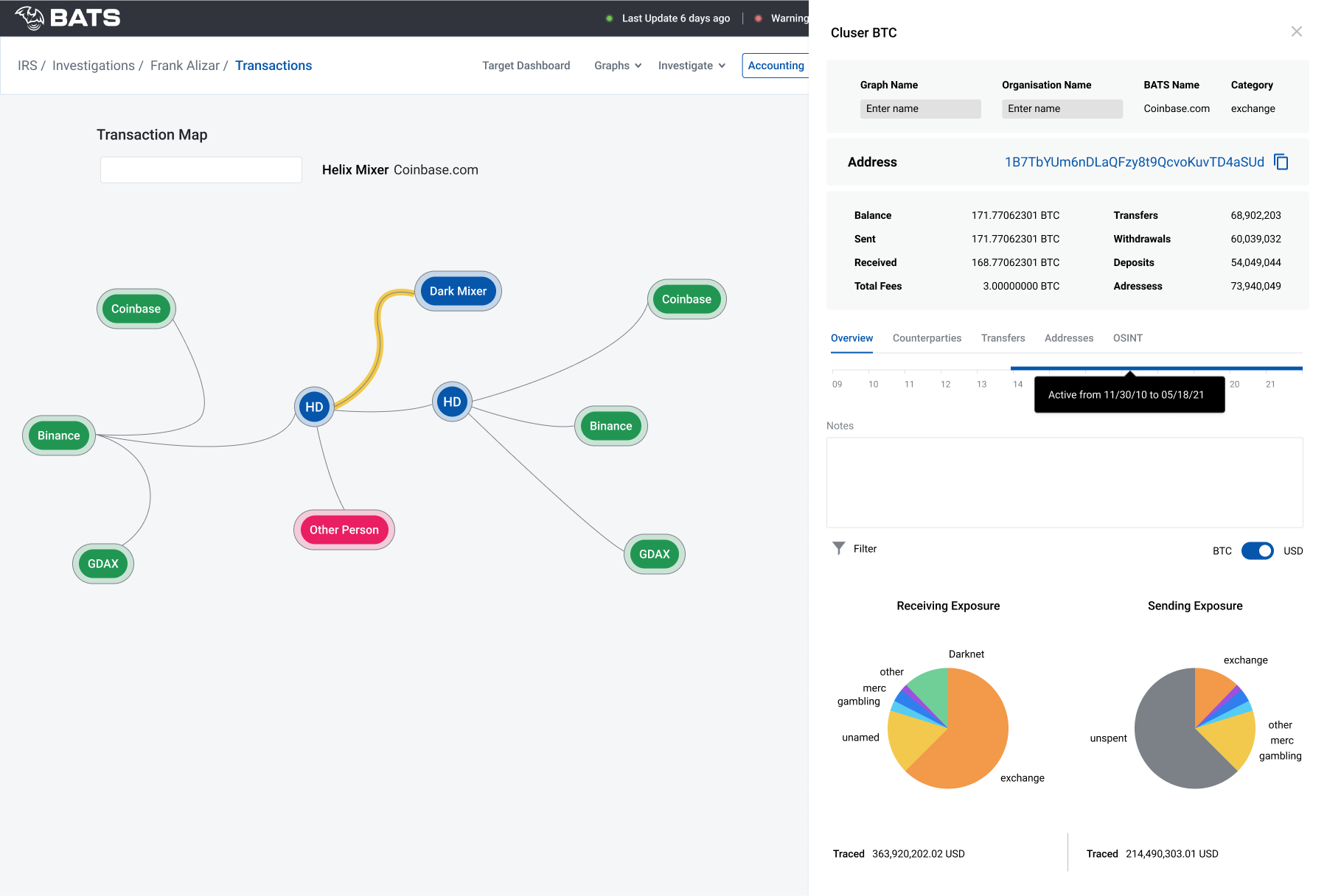
Transaction Map
Designed to show a clearer, step-by-step journey of money moving through wallets and exchanges.
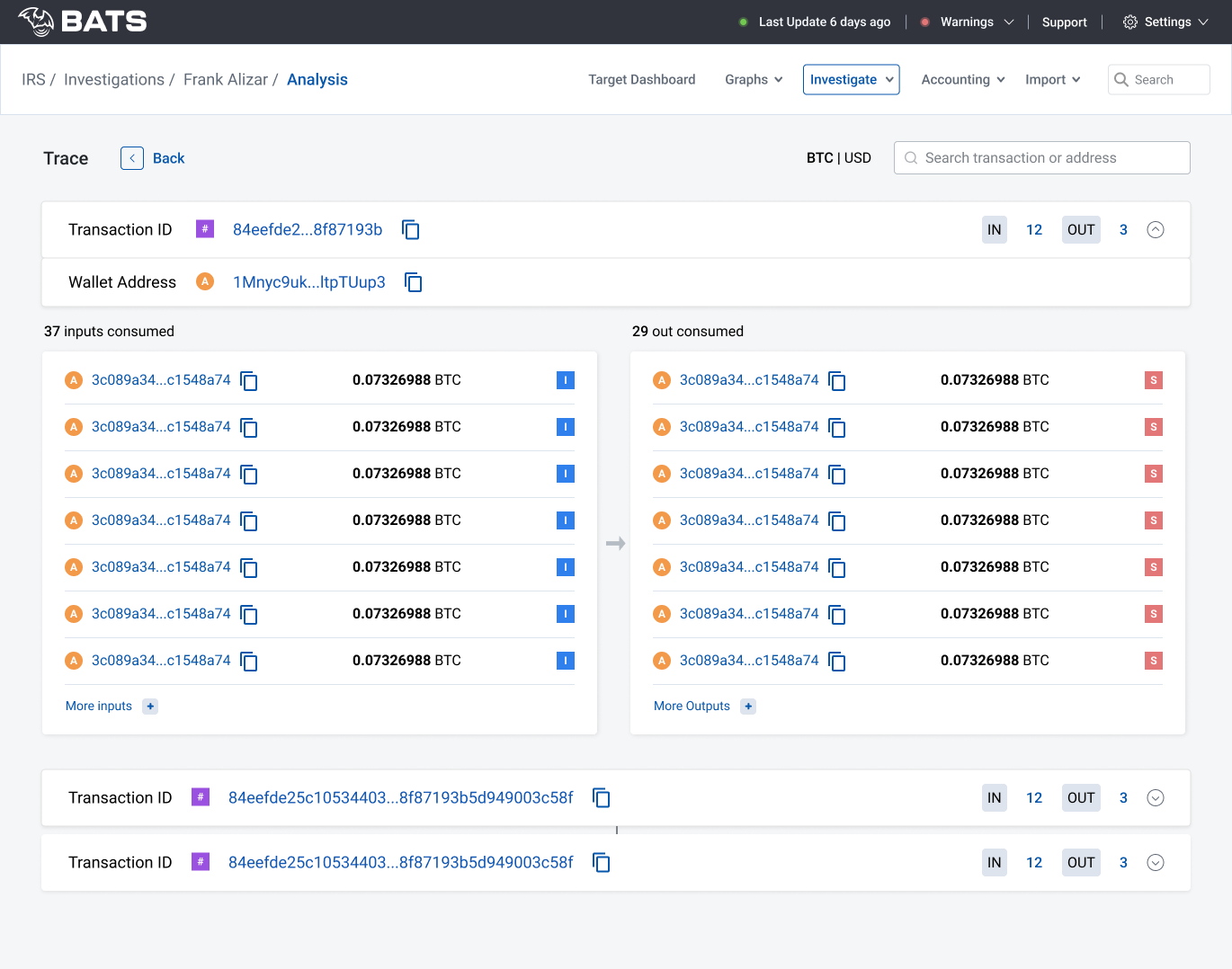
Trace
Updated for clarity, reducing clutter while making patterns more obvious.
Feedback and iteration
Each iteration was validated against IRS feedback, with investigators noting improvements such as.
- “Now I can actually see the flow without piecing it together myself.”
- “It’s much easier to trace one path and then branch out.”
Validating through users
Validation came through multiple channels:
- Stakeholder reviews with IRS teams.
- Feedback loops via customer service, who relayed investigator experiences.
- Analytics on task completion time and screen usage.
OUTCOME
Measurable Impact
Faster workflows and clarity in interactions
Redesigned user flows and key investigative screens, introducing clearer workflows and modern UI patterns.
How we know
Investigator feedback reported faster navigation and reduced confusion; analytics showed higher completion of investigative tasks.
Why it matters
Improved efficiency meant law enforcement teams could spend less time fighting the interface and more time uncovering fraudulent activity.
Reflections
This project reinforced the importance of designing for clarity in complex, high-stakes environments.
Even without direct access to users, I learned how to extract actionable insights from second-hand feedback and validate through iteration.
Next steps
Introduce role-specific dashboards for different investigator types.
Add guided workflows with progress steppers for onboarding new users.
Explore multi-chain imports to streamline complex investigations further.

Previous Case Study
Next Case Study

Got a project in mind?
Let’s work together
Say Hello
CASE STUDIES


Conquering Crypto Crime
BATs is a blockchain investigation platform used by law enforcement and the IRS to trace complex crypto transactions. It aggregates data from wallets, exchanges, and subpoenas, helping investigators detect fraud, follow financial flows, and build stronger cases.
My Contribution
As the sole Product Designer on BATs, I was responsible for reshaping the experience. Over five years, my work spanned redesigning the information architecture, creating investigative workflows, and building a scalable design system. I delivered more than 70 redesigned screens, from dashboards and transaction flows to detailed graphs, admin tools, and reporting interfaces.
Client
BATs - Blockchain Investigations SaaS Platform
Category
Fintech, Blockchain/Crypto Web3, Security
Team
2 Developers, 1 Product Owner
Timeline
1 Months
Problem
When I joined BATs, the platform already contained a lot of data: dashboards, transaction details, addresses, users, and case files. But what it didn’t have was structure. Investigators from agencies like the IRS told us they struggled to follow even simple workflows.
The existing designs were outdated and fragmented. There was no real flow tailored to the main user type, investigators. This made tracing complex blockchain transactions slow, confusing, and inefficient.
Solution
The focus was on introducing clear, investigator-centred flows. My goal was to reduce cognitive load, increase efficiency, and make complex investigations more intuitive.
RESEARCH
Key Findings
Understanding the pain points
I started by mapping out investigator journeys based on feedback gathered from the customer service team and key IRS stakeholders. These insights highlighted pain points such as:
- “I don’t know where to begin when opening a case.”
- “The steps to connect transactions feel scattered.”
- “I lose track of progress when switching between dashboards.”
Translating into flows
Using this input, I created user flows that defined clear entry points, logical steps, and outcomes. These flows then informed the redesign of key screens, simplifying layouts and surfacing the most relevant data at each stage.
Collaboration & Constraints
Dev collaboration
Working with developers was primarily async due to distributed teams. I collaborated closely through shared tools, annotated designs, and clear documentation to ensure smooth handoff.
Key constraints
- No direct access to end users → I relied on feedback passed through customer service and stakeholder proxies.
- Legacy codebase → Certain UI patterns had to be reworked to fit technical realities.
- Limited dev bandwidth → I prioritised changes that gave maximum user impact with minimal development lift.
DESIGN
Redesigning Key Screens
Sitemap - Leads
Sitemap showing the bottom up flows, where an investigation starts with an address or transactions.
Sitemap - Investigators
Sitemap showing the top down flows, where an investigation starts with a person.
Dashboard
Reorganised to highlight priority cases and active investigations.
Target Dashboard
Redesigned for a clear view of most pertinent information for targets.
Transaction Map
Designed to show a clearer, step-by-step journey of money moving through wallets and exchanges.
Trace
Updated for clarity, reducing clutter while making patterns more obvious.
Feedback and iteration
Each iteration was validated against IRS feedback, with investigators noting improvements such as.
- “Now I can actually see the flow without piecing it together myself.”
- “It’s much easier to trace one path and then branch out.”
Validating through users
Validation came through multiple channels:
- Stakeholder reviews with IRS teams.
- Feedback loops via customer service, who relayed investigator experiences.
- Analytics on task completion time and screen usage.
OUTCOME
Measurable Impact
Faster workflows and clarity in interactions
Redesigned user flows and key investigative screens, introducing clearer workflows and modern UI patterns.
How we know
Investigator feedback reported faster navigation and reduced confusion; analytics showed higher completion of investigative tasks.
Why it matters
Improved efficiency meant law enforcement teams could spend less time fighting the interface and more time uncovering fraudulent activity.
Reflections
This project reinforced the importance of designing for clarity in complex, high-stakes environments.
Even without direct access to users, I learned how to extract actionable insights from second-hand feedback and validate through iteration.
Next steps
Introduce role-specific dashboards for different investigator types.
Add guided workflows with progress steppers for onboarding new users.
Explore multi-chain imports to streamline complex investigations further.
Previous Case Study
Next Case Study
Got a project in mind?
Let’s work together
Say Hello